HR Learning Management System: Why Most Companies Don't Need a Traditional LMS Anymore
Summary
Traditional LMS platforms fail due to feature overload and tracking completions over competence. In 2026, a modern hr learning management system must prioritise outcome-based results, as you will explore in detail in this blog. By leveraging AI-powered assessments and microlearning, you can get clear progress visibility and true knowledge validation instead of just empty certificates.
"The biggest learning problem is not a lack of training. It is a lack of proof that employees learned anything."
For years, businesses invested heavily in Learning Management Systems (LMS) to organise training materials, assign courses, and track completions. Many organisations purchased large platforms packed with features, only to discover later that employees rarely used them beyond mandatory training sessions.
Today, workplace learning looks very different. Employees need faster access to knowledge. Managers need evidence of understanding. HR teams need visibility into skill gaps. Artificial intelligence (AI) in HR is accelerating that shift by making content creation, assessments, and learning delivery much easier.
In this guide, you'll learn:
- How a modern HR learning management system differs from traditional LMS
- Which learning management system features matter most in 2026
- How AI is changing employee learning
- Why assessments are becoming more valuable than course completions.
What Is an HR Learning Management System?

An HR learning management system is a software platform that helps organisations create, deliver, manage, track, and evaluate employee learning activities.
You can use an HR learning management system for:
- Employee onboarding
- Compliance training
- Policy education
- SOP training
- Product knowledge training
- Leadership development
- Skills improvement programs
- Certification management
Employee Training vs Employee Learning
To understand HR learning management systems, we need to understand the difference between employee training and employee learning first. Many use these terms interchangeably. But they are not the same. The table below will show you the difference at a glance.
| Employee Training | Employee Learning |
|---|---|
| Focuses on delivering information | Focuses on retaining and applying knowledge |
| Often event-based | Continuous process |
| Measures completion | Measures understanding |
| Usually one-way | Encourages ongoing development |
It is a positive sign that many modern organisations are increasingly recognising that learning cannot be treated as an annual activity. New technologies, changing regulations, evolving customer expectations, and AI adoption require employees to learn continuously throughout the year. Research also shows that organisations are placing greater emphasis on continuous learning and workforce upskilling to remain competitive.
Why Traditional LMS Platforms Create More Complexity Than Value
The global LMS market continues to grow rapidly, driven by digital learning and workforce development needs. Nevertheless, whether businesses generate meaningful value from large LMS implementations is a question to be debated. Common pain points associated with traditional LMS platforms include:
Feature Overload
Many traditional HR learning management systems were designed for large enterprises with extensive training teams. When SMEs opted for these systems, they got:
- Hundreds of configuration options
- Complex learning paths
- Advanced integrations
- Features that remain unused
A company may purchase a platform with 200 features, but its active usage might be limited to just 10 features in it. They pay for the unused features, though.
High Learning Curve
Many existing learning management systems require administrators to spend significant time understanding features:
- Configuring courses as per the employee departments
- Managing permissions for users
- Uploading content as per the participant requirements
- Building learning management system reports
- Generating learning management system analytics
- Troubleshooting user issues
Expensive Implementations
The advertised learning management system pricing or subscription cost rarely tells the full story. Many users find themselves spending additional expenses for:
- Platform setup
- Custom configuration
- Administrator training
- Content development
- Technical support
- Ongoing maintenance
Completion Tracking Becomes the Main Goal
Another common issue with traditional HR learning management systems is the fact that course completion is the only success metric. Employees just need to finish modules. They will get the certificates issued. HR leaders who look at the dashboards find that it looks healthy. Yet not even a quarter of the employees who took part in the program can confidently answer one question.
What Modern Businesses Need in an HR Learning Management System
Rather than focusing on course-centric learning models, it is important for modern organisations to focus on outcome-based learning. At a time of machine learning and artificial intelligence integration in HR, an innovative HR learning management system should support:
Fast Content Creation
HR teams or managers conducting the training should be able to create training materials quickly from existing documents, policies, SOPs, and presentations.
Knowledge Validation
Employees should be able to demonstrate their understanding through assessments rather than simply clicking through lessons.
Easy Participation
Learning should blend into everyday tasks so employees can grow without disrupting their normal workday.
Progress Visibility
Managers must have options to easily track how each employee is advancing and when they are ready for new responsibilities.
Skill Gap Identification
Companies require clear data to pinpoint exact areas where staff knowledge needs improvement.
Continuous Learning
Short, regular learning activities produce better engagement than annual training marathons. A modern hr learning management system should support microlearning and mobile-first learning.
Learning works best when it becomes part of everyday work rather than a separate project.
Essential Learning Management System Features to Look for in 2026
You come across learning management systems with hundreds of features. But do you really need all of them? Absolutely not. The following learning management system features deliver the most practical value for modern organisations.
AI-Powered Content Creation
AI can transform documents into structured learning content within minutes.
Examples include:
- Employee handbooks
- HR policies
- Compliance documents
- Standard operating procedures
Assessments and Knowledge Checks
Strong assessment capabilities help validate understanding and identify learning gaps.
Tracking
Managers should easily track:
- Learning completion
- Assessment scores
- Department progress
- Certification status
Certifications and Compliance Records
Organisations must maintain records for:
- Safety compliance
- Industry regulations
- Mandatory training
- Internal certifications
Mobile Accessibility
Employees increasingly consume learning content on mobile devices. Learning platforms must work smoothly on phones and tablets.
Learning Management System Reports
Look for an HR learning management system that can populate actionable reports from the raw data that can help HR teams monitor training effectiveness and get clear guidance for smarter decisions.
Learning Management System Analytics
Advanced analytics reveal trends that traditional completion metrics often miss. They uncover deeper patterns like engagement drops and skill growth over time.
The best learning platforms are not necessarily the ones with the longest feature list. They are the ones employees would definitely use.
Why Assessments Are Becoming More Important Than Courses
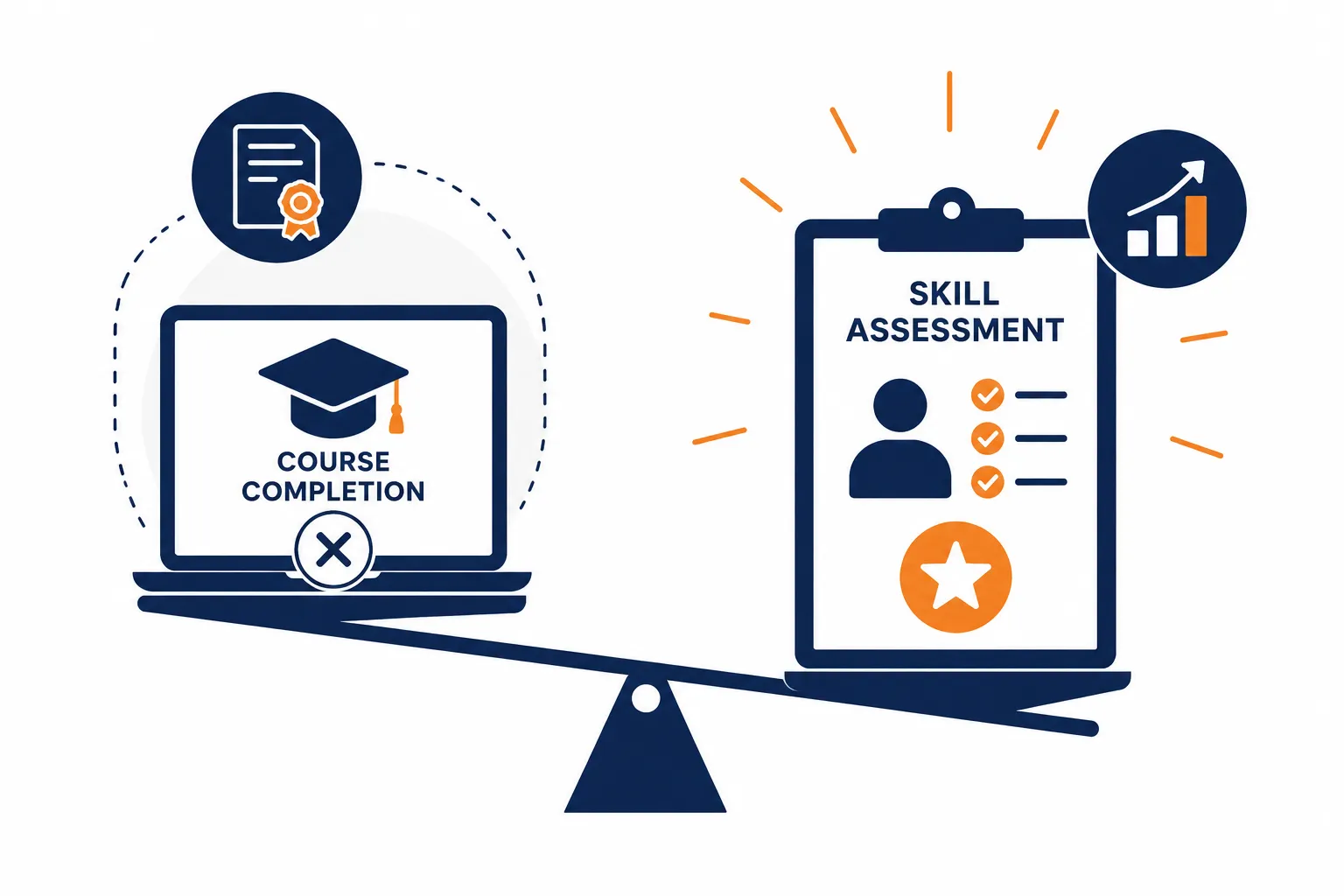
Any given employee can finish a course within the deadline, if forced, without absorbing much of the information. That creates a serious problem for HR leaders who are supposed to ensure that workers truly understand and can apply what they have learned.
If you want to make your employees accountable, a structured assessment is a great tool.
Through such tests, you can uncover:
- What employees understand
- What employees missed
- Which teams require retraining
- Which topics create confusion
Assessment-driven learning is especially valuable for:
- Safety Training: Employees must understand procedures that affect workplace safety.
- SOP Training: Knowledge checks verify that employees can follow operational processes correctly.
- Compliance Training: Regulators care about compliance outcomes, not just course completions.
- Product Knowledge Training: Sales and support teams need accurate product understanding.
- Sales Readiness Training: Assessment scores can indicate readiness before customer interactions.
As you focus more on measurable business outcomes, assessments become central to your modern HR learning management system.
How AI Is Changing Employee Learning
Artificial intelligence is reshaping workplace learning. AI-powered learning platforms are increasingly helping businesses personalise learning, identify skill gaps, and automate content creation.
Traditional course development may require:
- Content gathering
- Instructional design
- Course formatting
- Assessment creation
- Review cycles
That process can take weeks, but AI dramatically reduces that workload. For a practical example, imagine your HR team needs to train employees on a new policy. Instead of manually creating training material, you could:
- Upload policy documents.
- Upload SOPs and training files.
- Generate AI-powered learning content.
- Automatically create assessments.
- Assign learning activities.
- Track employee participation.
- Review assessment performance.
The result is faster learning deployment and faster feedback, which is why many organisations now prioritise learning systems that connect knowledge acquisition with measurable performance outcomes rather than simply managing course libraries.
Can a Gamified Learning Management System Improve Participation?
Employee participation remains one of the biggest training challenges.
Many workers ignore optional training because it feels disconnected from their daily responsibilities. A gamified learning management system attempts to increase engagement using game-inspired mechanics such as:
- Points
- Badges
- Leaderboards
- Milestones
- Achievement recognition
Benefits may include:
- Higher participation rates
- Increased motivation
- Better learning consistency
- Greater visibility of achievements
Gamification is not a replacement for quality learning content, but it can help maintain engagement when used thoughtfully.
How Learning Management System Reports Help HR Teams Make Better Decisions
It is surprisingly true that many HR teams don't get the most out of their learning management system reports. That's a shame, because when used well, these reports could turn boring training data into real, actionable insights. And with the help of these very reports, you can run things much better. Here are some of the most useful learning management system analytics and reports you should be looking at:
- Completion Reports: Identify employees who have not completed mandatory training.
- Department-Wise Progress: Compare learning participation across teams.
- Assessment Performance Reports: Reveal areas where employees consistently struggle.
- Compliance Tracking Reports: Provide evidence for audits and regulatory reviews.
- Training Effectiveness Reports: Highlight which programs produce strong outcomes and which need improvement.
How Mewurk Supports Employee Learning Without a Traditional LMS
You do not need a massive LMS deployment. You just need a practical way to create learning activities, validate knowledge, and monitor progress. Mewurk approaches employee learning from that perspective.
Instead of positioning itself as a traditional HR learning management system, Mewurk helps you integrate learning, assessment, and employee development into your everyday HR processes. With Mewurk AI Assessment, you can create role-specific tests, evaluate employee knowledge, identify skill gaps, and measure learning outcomes without managing a separate LMS platform.
- Generate AI-powered learning content
- Create AI-generated assessments
- Conduct employee evaluations
- Run monthly learning activities
- Validate employee knowledge
- Track learning progress
If you are a growing business, this approach delivers more value than maintaining a standalone HR learning management system filled with features that rarely get used.
Final Thoughts
AI is changing workplace learning at a remarkable pace. A traditional HR learning management system still makes sense for some large enterprises with complex learning requirements. Most SMEs, however, need practical learning tools that focus on knowledge validation, assessments, reporting, and visibility rather than endless features.
If you found this guide useful, consider sharing it with colleagues, HR leaders, and business owners who are evaluating employee learning solutions. Wishing you continued success in building a smarter workforce.
Frequently Asked Questions (FAQ)
1. What is an HR learning management system?
An HR learning management system is software that helps you (businesses, organisations, or companies) create, deliver, track, and evaluate employee learning activities such as onboarding, compliance training, skill development, and certifications.
2. What are the most important learning management system features in 2026?
The most valuable learning management system features include AI-powered content creation, assessments, mobile access, progress tracking, certifications, reporting, analytics, and skill gap identification.
3. How does AI improve employee learning?
AI can generate learning content from policies, SOPs, and training materials, create assessments automatically, personalise learning paths, and help HR teams identify knowledge gaps faster.
4. Can a gamified learning management system increase engagement?
A gamified learning management system can improve participation through points, badges, leaderboards, milestones, and achievement recognition. These incentives or positive reinforcements will encourage employees to engage with learning activities.
5. How should businesses evaluate learning management system pricing?
When reviewing learning management system pricing, consider implementation costs, content creation expenses, administration effort, support fees, and long-term maintenance costs in addition to subscription pricing.

Most Popular Post

Why Accurate Attendance and Leave Management Matters for Business Growth?
Read More →Why Accurate Attendance and Leave Management Matters for Business Growth?
How To Leverage Attendance Data For Better Workforce Management?
Read More →How To Leverage Attendance Data For Better Workforce Management?