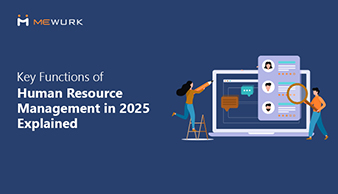
Key Functions of Human Resource Management in 2025 Explained
Human Resource Management is often taught in bullet points. Planning, organising, recruiting and training are the usual suspects. The problem with this type of understanding of HR management is that this textbook pattern flattens HR into tidy definitions, while in real workplaces, HR is anything but tidy. It’s unsystematic, contradictory, occasionally thankless, but always central.
So instead of cataloguing the functions of human resource managementlike a glossary, let’s look at them as they exist in 2025. This blog will unpack those functions in their respective contexts and show you exactly how they play out in modern workplaces.
What Are the Different Types of Functions of Human Resource Management?
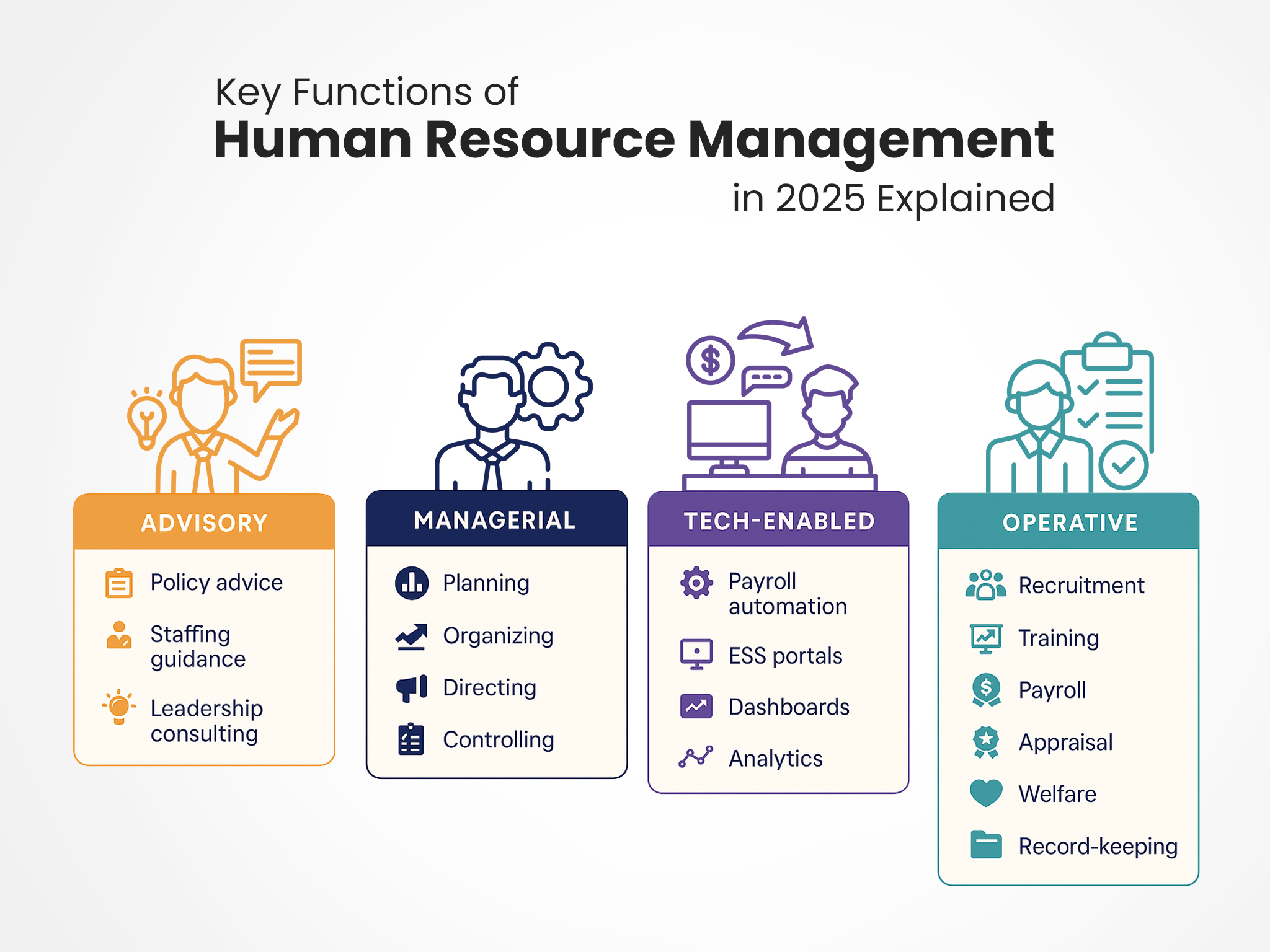
When we talk about the different functions of human resource management, they fall into three neat boxes: managerial, operative, and advisory.
Putting the objectives and functions of human resource management into structured categories like this is useful as a starting point. Managerial functions keep the strategy in line. Operative functions keep the daily operations on track and aligned with the daily flow of work. Advisory functions position HR as the authentic consultant to leadership.
And in 2025, there’s a fourth category we can’t ignore: technology-enabled functions. Let’s look at each of these in detail below.

Managerial Functions of Human Resource Management
There are 4 functions of human resource management under the managerial category. They are:
Planning
The word sounds too technical or gives off a rigid vibe, but planning is nothing less than asking: Who do we need tomorrow, and how will we find them today? In old-school human resource management, planning meant headcount projections in spreadsheets. In 2025, it’s predictive analytics, attrition modelling, and raising the question of whether your future team will resemble your current one.
Organizing
As we go deeper and dissect the concept and function of human resource management, the next step is organising. But it is far from drawing flowcharts or ticking boxes. It is about translating plans into real frameworks and building structures that don’t collapse under hybrid work.
When you have one team operating in Mumbai and another in Berlin, and half the company is remote, the reporting line loses its organised structure. But that is how most workplaces are doomed to function today.
The functions of strategic human resource management here are not to impose rigid structures, but to keep enough clarity so people know who they must answer to without wasting time figuring it out.
Directing
This is the softest among all the other managerial functions of human resource management. But don’t take it lightly lest it should turn out to be the hardest. Directing means more than telling people what to do.
It should be aimed towards motivating them to care about what they’re doing in the first place. In 2025, motivation cannot be bought with a free lunch and a Fun Friday. It can only be built through a healthy organisational culture, communication, and giving employees a say in decisions that affect them.
Controlling
Controlling has become the least fashionable word in HR, but you cannot avoid it, no matter how you frame it. In the new context of understanding the managerial and operative functions of human resources, having control or controlling means measuring whether employees actually meet the goals you planned for them.
If the old way was annual appraisals, the new way is dashboards with real-time performance data. What has drastically changed here is not the functions but the lens through which we must look at it.
Operative Functions of Human Resource Management
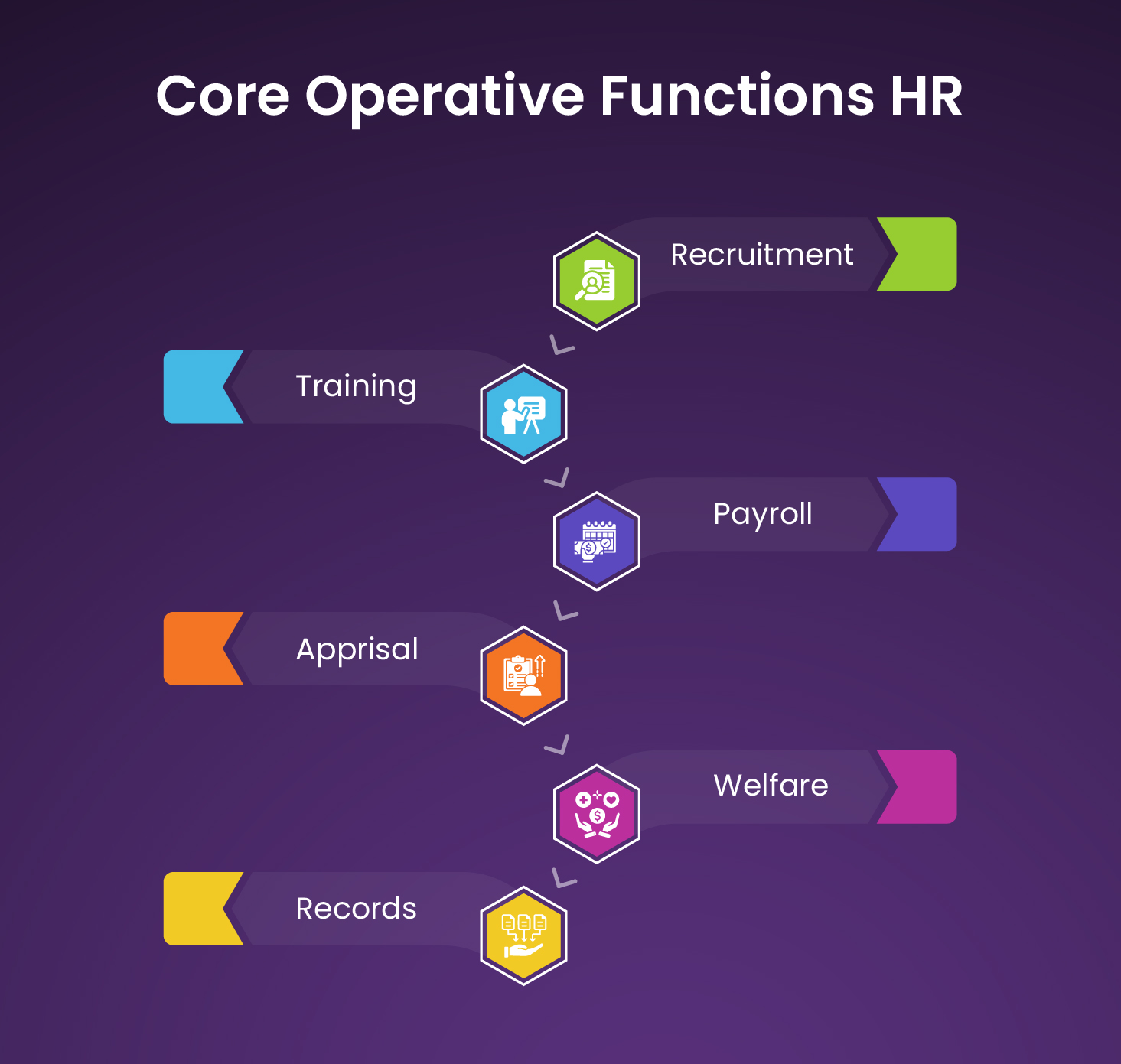
If managerial functions are about direction, operative functions are about execution. These are the gears that keep the HR machine from seizing up.
Recruitment & Selection
Everyone calls it hiring, but recruitment is what builds the DNA of your organisation. In 2025, this means leaning on AI to screen resumes, but also remembering that AI doesn’t know the difference between a good employee and a great one. HR still does.
Training & Development
Training has always been one of the most optimistic functions of human resource management. The belief that you can take an average employee and make them extraordinary.
Sometimes you can. In today’s context, training doesn’t always come in the form of week-long workshops. It can show up in different learning styles like microlearning, adaptive courses, and nudges on your phone that remind you to upskill because tomorrow’s job won’t wait for you to catch up.
Compensation & Payroll
When we look at the various functions of human resource management, the least glamorous but the most sensitive one among them could becompensation and payroll.
Pay is where theory meets reality. There’s nothing as damaging to trust as errors in payroll. And yet, it’s still where many HR teams stumble. That’s why payroll is now inseparable from technological innovations like ESS portals, where employees can view payslips instantly, tax-ready statements without begging HR.
Performance Appraisal
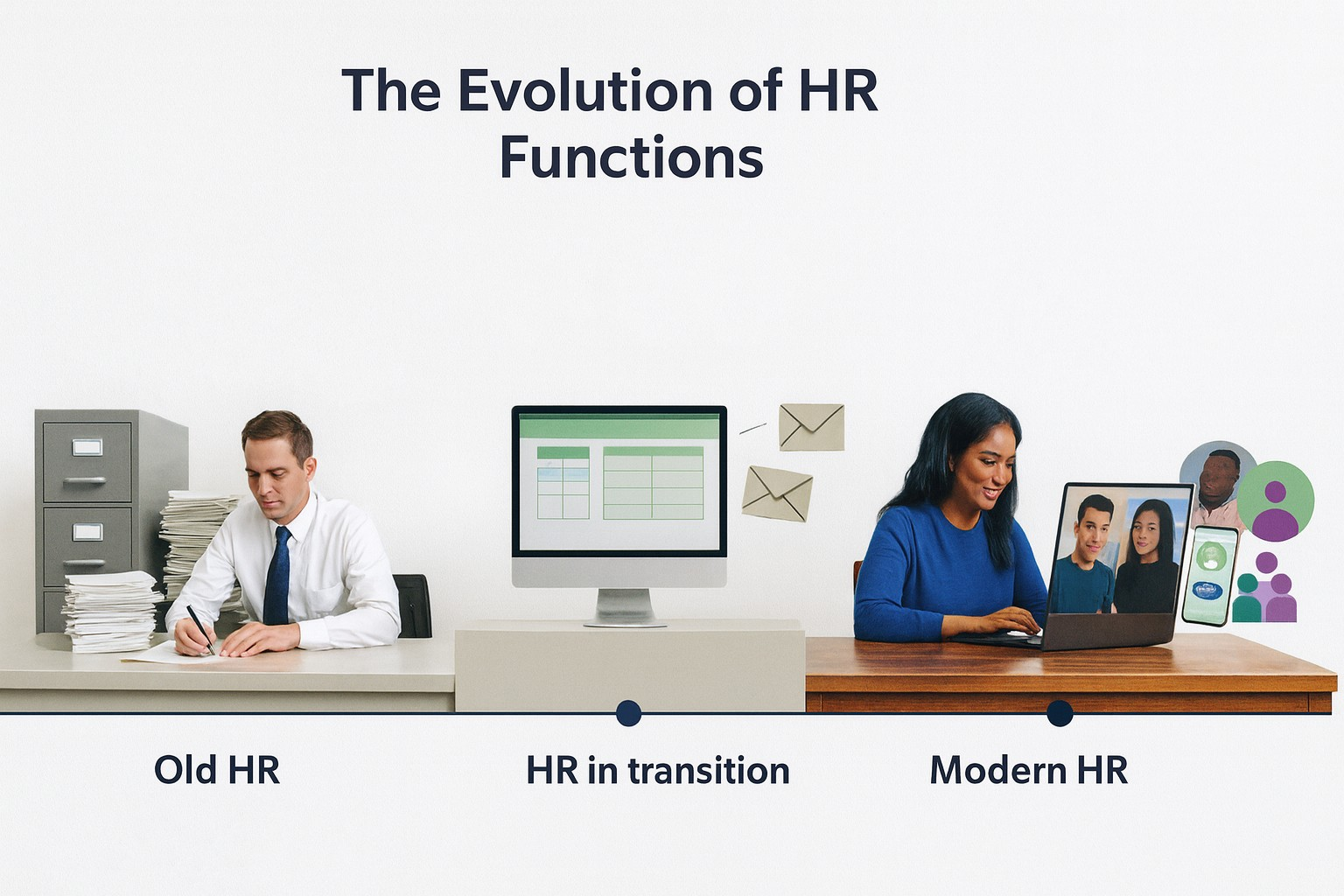
Although we generally phrase it as a performance appraisal, at its core, it’s recognising employees for their contributions. Every employee wants to and deserves to know that their work matters. Old-school HR made it an annual ritual. Modern HR knows feedback can’t wait a year and that it has to be a continuous process. If payroll is trust in numbers, appraisal is trust in people.
Employee Welfare & Relations
Once, welfare was limited to a few things like health insurance and maybe food coupons for the office canteen. Now it also involves mental health programs, flexibility, inclusion, and creating space for employees to thrive without burning out. Employee relations have evolved to the point of building cultures where friction doesn’t silently fester.

Record Keeping & Compliance
If you ask HR teams to explain the functions of human resource management, record keeping won’t be the part they brag about. Nobody gets into HR for the joy of filing records and meeting compliance checklists. But records are the skeleton of people management, and without them, the structure crumbles.
Advisory Functions of HRM
Here’s where HRs wear their consultant hats. They do it on multiple levels. Advising top management on policies. Advising department heads on staffing decisions. While it is among the most powerful 5 functions of human resource management, it also happens to be the least visible of them, thanks to the subtle way advice shapes decisions.
HR knows things leaders don't. They see the numbers and hear the complaints that never make it to the top. Their job is to take all that information and turn it into a plan for the company. Hence, they have to be the ones to tell the bosses what is happening.
Technology-Enabled Functions of HRM
This is the category no professor in the 1970s thought to add, but if you open any functions of a human resource management ppt today, it’s the one transforming everything else.

HR Automation has reached the potential to cover different facets of employee management. Automation of payroll, self-service portals for leave, and real-time dashboards for attendance. A shift from HR as gatekeeper to HR as enabler.
Sophisticated tools like Mewurk HR Management Software strip out the friction while keeping the relevance of the human side of HR functions intact. Technology smooths the process, but human judgment, empathy, and leadership define the outcome.
Why Do the Functions of Human Resource Management Matter Today?
Every company claims that people are its greatest asset. But only a few prove it in practice. The real difference between organisations that thrive and those that stall isn’t the size of their marketing budget or their tech stack. The question is whether HR is reduced to admin tasks or valued as the backbone of trust.
Call them managerial, operative, advisory, or tech-enabled, these core functions of human resource management shape the culture, the trust, and ultimately whether people stay or leave.
Conclusion
Over the years, the functions of human resource management have changed in practice. But the heart of it remains the same. Human resource management exists to connect people to purpose, and purpose to performance.
That’s our take on the functions of HRM and how they keep evolving. We would love to know how this landed with you. Did it match your own experience in HR? And if you think someone in your circle would enjoy this read, feel free to share it along.
FAQ
What are the functions of human resource management in 2025?
The core functions are still managerial, operative, and advisory, with a fourth tech-enabled category now shaping modern workplaces.
Why are the functions of HRM important for organisations?
Because these functions go beyond administrative tasks and directly impact employee trust, workplace culture, job performance, and employees’ decision to stay or leave. While a function of human resource management PDF might list them as neat bullet points, in reality, they unfold in ways that influence how people experience work every day.
How is technology changing HR functions today?
Technology has stripped away a lot of the grunt work, like processing payroll, pushing leave forms through inboxes, and tracking attendance manually. And thanks to automation, HR teams are now free to spend more time on the parts of the job that need judgment.

Most Popular Post

Why Accurate Attendance and Leave Management Matters for Business Growth?
Read More →Why Accurate Attendance and Leave Management Matters for Business Growth?
How To Leverage Attendance Data For Better Workforce Management?
Read More →How To Leverage Attendance Data For Better Workforce Management?